When brands develop small-sized woven labels for bags or accessories, they often face a difficult balance between design complexity, size limitations, and cost control. This case is a typical example of how the right process choice can turn a challenge into an opportunity.
Customer Background & Initial Challenge
The client planned to sew woven labels onto bags. However, the provided artwork was highly complex, with very fine lines, and the final label size was limited to just 3 × 3 cm.
Additional constraints made the project even more challenging:
- Small initial quantity: 100 pcs per design
- Five different designs
- High sensitivity to cost
- Strict expectations for visual clarity

Under these conditions, producing a traditional woven label would have resulted in either:
- Loss of detail due to weaving limitations at small sizes, or
- A significantly higher unit cost that didn’t suit small-batch production.
Process Evaluation & Solution Recommendation
After evaluating the design complexity, label size, and cost structure, we recommended a Satin + Printed Label solution.
Why Satin Printed Labels?
This solution offered a balanced advantage:
- Maintains the soft hand feel and premium appearance associated with woven labels
- Allows precise reproduction of fine lines and complex graphics
- Significantly reduces cost compared to traditional weaving in small quantities
For small-sized tags with intricate artwork, satin printing provides far greater visual freedom than woven structures.
Key Technical Challenge During Implementation
The most critical challenge in production was:
How to accurately reproduce ultra-fine lines on satin material
Satin has a smooth surface and fine texture, which can easily cause:
- Blurred edges
- Ink bleeding
- Loss of sharp detail
Using standard processes, achieving clarity at a 3 × 3 cm size would be difficult.
How We Solved the Precision Issue
Thanks to our established technical capability in printed labels, we addressed this challenge through:
- Optimizing printing resolution
- Adjusting ink formulation to control spreading
- Fine-tuning heat press parameters for better fixation and clarity
These adjustments ensured that even at a very small size, the complex patterns and thin lines remained crisp and legible, fully meeting the client’s visual and quality expectations.
Final Result & Customer Feedback
The client was highly satisfied with the sampling result:
- Design details were clearly presented
- The label maintained a premium look and soft feel
- Cost targets were met
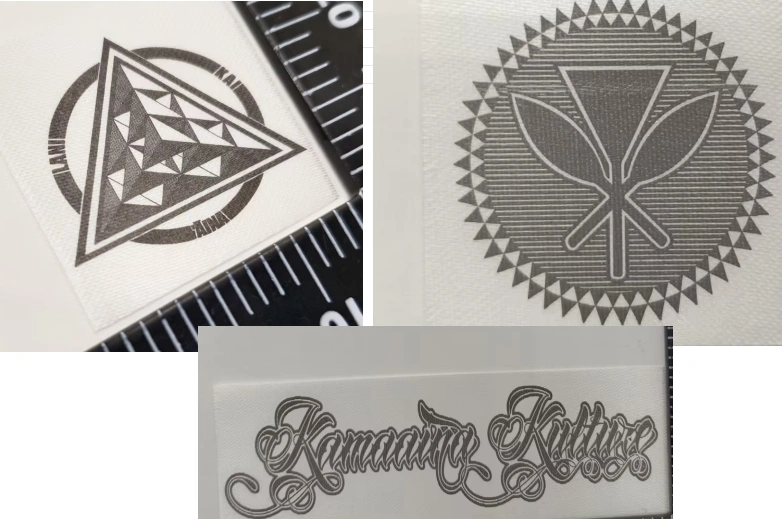
As a result, the customer increased the order quantity from 100 pcs per design to 1,000 pcs per design, turning a small trial project into a scalable production order.

Conclusion: When Small Size Requires a Smarter Solution
For small-sized woven labels and small-sized tags, especially when artwork is complex and quantities are limited, satin printed labels can be a far more effective solution than traditional weaving.
By choosing the right process and optimizing technical details, brands don’t have to compromise between design precision, quality, and cost—even at very small sizes.
About Author
——————————————————————————————————————————————

Mary
Sales Manager
Hi, I’m Mary. Passionate about exploring new industry trends, I stay ahead of the curve and offer clients forward-thinking solutions tailored to their needs.
——————————————————————————————————————————————