A well-designed clothing hang tag does more than display brand information. Its paper texture, embossing, logo finish, and overall craftsmanship all contribute to how customers perceive a brand. In this project, QingHan helped a client preserve an existing hang tag design while improving the embossed logo and the flatness of the back surface.
A New Hang Tag Development Project: Keeping the Original Design
Recently, we worked with a client to develop a new version of their existing brand hang tag.
Before contacting us, the client already had a hang tag produced by a previous supplier. The original design featured white specialty paper, delicate floral embossing, and a centrally positioned brand logo. The combination created an elegant and understated appearance with a refined paper texture.
The overall design was already well developed. The client did not want to change its visual identity. Instead, they wanted a new supplier to reproduce the same design direction while improving certain product details.
At first glance, this appeared to be a straightforward custom hang tag production project. However, after receiving the original sample, our engineering team identified an opportunity to improve the manufacturing process without changing the design the client liked.

Identifying the Problem: A Good Front Design Does Not Guarantee a Perfect Back
Before developing the new sample, our engineers carefully examined the original hang tag supplied by the client.
The original product used floral embossing to create a decorative surface texture, together with a dimensional brand logo. From the front, the floral pattern and logo created an attractive layered appearance.
However, when we inspected the back, we noticed an issue.
The raised embossing on the front had created corresponding indentations on the reverse side of the paper. As a result, the back surface was not as flat and clean as expected.
For some ordinary hang tags, this may seem like a minor detail. But for brands that pay close attention to product presentation, both sides of a hang tag matter.
Consumers may turn a hang tag over to read product information, check the brand details, or simply examine its construction. Visible indentations on the reverse side can affect the overall impression of quality.
We therefore decided that the goal should not be to simply copy the original sample. It should be to preserve its design characteristics while improving the areas where the original production process could be refined.
Improving the Embossed Logo Without Changing the Design
After confirming the client’s preferred design direction, our engineering team focused on adjusting the embossing process and the structure of the hang tag.
The first priority was to retain the original visual elements:
- White specialty paper
- Delicate floral embossed texture
- Original logo placement and overall layout
- Elegant combination of white paper and a gold logo
We then focused on improving the dimensional appearance of the logo.
By adjusting the embossing process, we aimed to make the logo’s raised effect clearer and more defined. The gold logo stood out more distinctly against the white paper, creating a stronger visual hierarchy while maintaining the original elegant style.
At the same time, we worked on reducing the impact of the front-side embossing on the reverse surface.
By refining the production approach, the new sample achieved a flatter and cleaner back, with fewer visible indentations caused by the front-side raised details.
The key was to improve the product without redesigning it. The client could retain the original visual identity while receiving a more refined result on both sides of the hang tag.
Original vs. New Hang Tag: What Changed?
Comparing the original supplier’s sample with our new sample makes the improvements easier to understand.
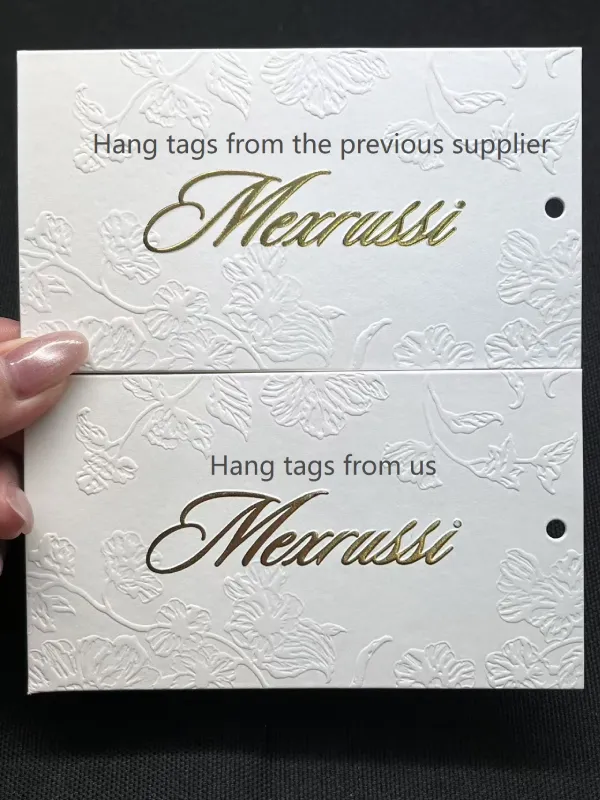
Front-Side Comparison: A More Defined Embossed Logo
The original hang tag already featured a gold brand logo with a dimensional effect.
In the new sample, we refined the raised logo appearance to make the brand mark look more defined and visually prominent. Its relationship with the floral embossed texture also became more balanced.
The objective was not to make the logo unnecessarily exaggerated, but to improve its clarity and dimensional presentation while keeping the original design language.
Back-Side Comparison: A Flatter and Cleaner Surface
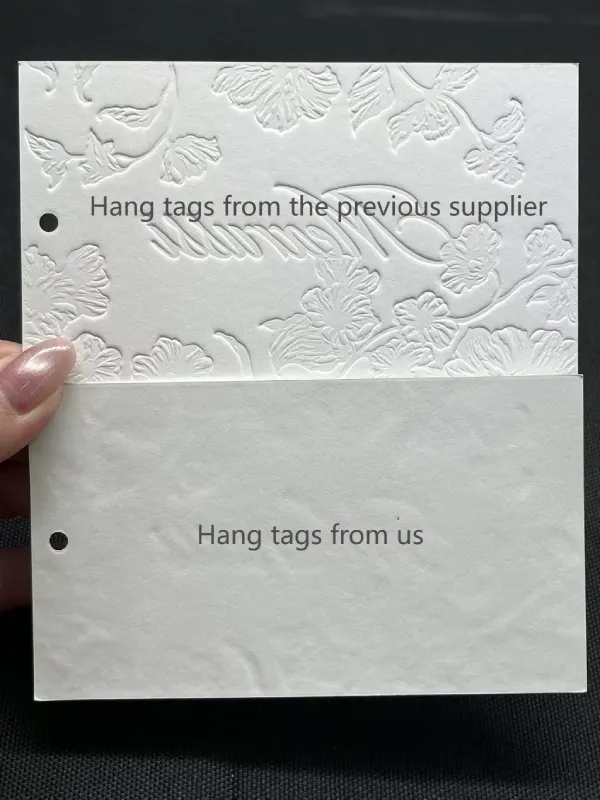
The reverse side showed one of the most important improvements in this project.
On the original sample, the indentations created by the front-side embossing were visible on the back. On our new sample, these unwanted impressions were reduced, resulting in a flatter and cleaner appearance.
This type of improvement requires attention to several production factors, including the embossing structure, pressure, paper characteristics, and process settings.
Although the difference may appear subtle, it reflects a more careful approach to hang tag manufacturing.
A quality hang tag should not only look attractive from the front. Its reverse side should also be considered during product development.
What Makes Good Hang Tag Detail Design?
This project illustrates an important point about custom hang tag development: small production details can have a meaningful impact on the finished product.
When evaluating a hang tag design, brands and manufacturers should consider more than its artwork.
1. Paper Selection and Surface Characteristics
Paper type affects the appearance, texture, stiffness, and processing performance of a hang tag.
Specialty papers can create distinctive visual and tactile effects, but their behavior during embossing, debossing, and other finishing processes may vary.
The paper should therefore be selected according to both the design requirements and the intended production techniques.
2. Embossing Depth and Pressure
Embossing creates raised patterns by applying pressure through a matched die structure.
The depth and clarity of the raised effect depend on factors such as paper properties, die design, pressure, and production settings.
Excessive or poorly controlled pressure may create unwanted impressions on the reverse side. For designs that require a clean back surface, this should be considered during sampling.
3. Logo Finishing and Visual Hierarchy
A brand logo can be enhanced through techniques such as embossing, debossing, and foil stamping.
For example, a gold foil logo on white specialty paper can create a refined appearance. When combined with floral embossing, the different finishes add visual layers without requiring a complicated design.
The important point is to ensure that the logo remains clear and visually balanced with the surrounding decorative elements.
4. Both Sides of the Hang Tag
The front usually receives the most attention during design development, but the back should not be overlooked.
Brands should check:
- Whether front-side embossing creates unwanted marks on the back
- Whether printed information remains clear and readable
- Whether the paper surface is sufficiently flat
- Whether the overall thickness and stiffness meet the product requirements
Reviewing both sides during sampling helps prevent small finishing issues from being overlooked before mass production.
Our Approach to Hang Tag Development: Improve, Do Not Just Copy
In apparel accessory development, it is common for a brand to approach a new supplier with an existing design or a physical sample from a previous manufacturer.
The brand may already be satisfied with the overall appearance but still want better quality, more consistent production, improved finishing, or a solution to an existing product issue.
This is where a manufacturer’s development experience becomes valuable.
At QINGHAN, we do not treat a reference image or physical sample as something that must simply be copied without evaluation. We consider the product structure, material characteristics, and manufacturing processes to identify potential improvements.
Sometimes the opportunity lies in the dimensional appearance of a logo. In other projects, it may involve paper selection, embossing depth, edge finishing, foil stamping, or even a detail on the back of the product.
These adjustments may not dramatically change the overall appearance, but they can make the finished product more complete and consistent with the brand’s expectations.
A reliable manufacturing partner should be able to do more than follow production instructions. It should also be able to identify potential problems and work with the client to improve the result.
Frequently Asked Questions About Custom Hang Tag Design
1. Can a manufacturer improve an existing hang tag without changing its original design?
Yes. A manufacturer can evaluate the original sample and identify opportunities to improve paper selection, embossing, foil stamping, logo definition, or other finishing details while retaining the original layout and visual style.
2. Why does embossing on the front create marks on the back of a hang tag?
Embossing applies pressure to the paper to create a raised surface. Depending on the paper characteristics, die structure, embossing depth, and pressure, corresponding impressions may appear on the reverse side. The production process can be adjusted to reduce unwanted marks, although the achievable result depends on the material and design.
3. Can a gold logo be combined with floral embossing?
Yes. Gold foil stamping and floral embossing can be combined to create different visual and tactile layers. The final effect depends on the paper surface, foil compatibility, die design, and production settings.
4. What should I check when comparing hang tag samples from different suppliers?
Look at both sides of the tag, not just the front. Check the logo definition, embossing consistency, paper texture, foil finish, edge quality, surface flatness, and overall construction. For repeat orders, also confirm that the approved sample can be used as a production reference.
5. Do I need to provide a physical sample for custom hang tag development?
A physical sample is helpful when you want to reproduce an existing product or improve specific manufacturing details. If a physical sample is unavailable, clear artwork, dimensions, paper specifications, finishing references, and photographs can help the manufacturer evaluate the project.
Final Thoughts: Every Detail Should Reflect the Brand
From examining the original hang tag to adjusting the embossing process and comparing the new sample with the previous version, this project demonstrated how small manufacturing improvements can make a difference to the finished product.
A clothing hang tag may not be part of the garment itself, but it is often one of the first branded elements customers handle when they receive a product. Its paper quality, logo finish, surface texture, and construction all contribute to the brand experience.
For QingHan, sample development is not simply about reproducing an existing design. It is an opportunity to help clients identify problems, refine production details, and create a better finished product.
If you are looking for a new hang tag supplier or want to improve the embossing, debossing, foil stamping, paper selection, or other details of your existing hang tags, you are welcome to share your artwork or physical sample with us.
QINGHAN is more than an apparel accessories manufacturer. We aim to be a reliable product development partner for your brand.
Yazar Hakkında
——————————————————————————————————————————————

Heidi
Satış Müdürü
Merhaba, ben Heidi, Satış Müdürü. Profesyonellik ve verimlilikle tanınan ben, genellikle en iyi satış performansı gösteren kişi olarak tanınırım. Uzmanlık ve özverinin müşterilerde kalıcı güven oluşturduğuna inanıyorum.
——————————————————————————————————————————————