What Is the Best Way to Make Full-Color Printed Leather Patches in Small Quantities?
For full-color printed leather patches with complex artwork and small order quantities, digital spray printing is often more cost-effective than traditional CMYK plate printing. It eliminates high setup costs while achieving excellent color accuracy, gradients, and photo-level detail.
Project Background: When Artwork Complexity Meets Quantity Limits
This project started with a client request for a full-color (CMYK) printed PU leather patch. The artwork was visually rich, featuring:
- Multiple colors
- Fine details
- Gradients and layered elements
The total order quantity was 500 pieces—not extremely small, but not large enough to absorb high setup costs easily.
At this stage, the key question was not whether the patch could be produced—but how it should be produced.
The Original Plan: Traditional CMYK Printing on PU Leather
The client initially expected to proceed with standard four-color (CMYK) printing, a method commonly used for full-color graphics.
Advantages of Traditional CMYK Printing
- Stable color output
- Proven process for large runs
- Consistent results once plates are made
However, CMYK printing comes with an important limitation.
Why Traditional CMYK Printing Was Not Ideal
Plate-Making Cost
CMYK printing requires:
- Four separate printing plates
- Precise color alignment
- Upfront plate setup fees
For large-volume production, these costs are spread across many units.
For 500 pieces, however, plate fees significantly increase the unit cost.
Cost vs. Quantity Imbalance
When we evaluated the total cost structure, it became clear:
- The printing itself was not the problem
- The plate cost made the project inefficient
Simply following the original plan would have delivered acceptable quality—but at an unnecessarily high cost.
Understanding the Client’s Real Priorities
Before suggesting an alternative, we clarified the client’s core needs:
- High fidelity to the original artwork
- Accurate color reproduction
- Ability to render gradients and complex patterns
- Reasonable cost for a mid-small batch
Importantly, brand quality mattered more than sticking to a specific process.
The Recommended Alternative: Digital Spray Printing
Based on these priorities, we recommended switching to digital spray printing for the PU leather patches.
Why Spray Printing Made Sense
Unlike traditional CMYK printing, spray printing:
- Requires no printing plates
- Is ideal for small to medium batch quantities
- Handles complex graphics, gradients, and photo-like effects extremely well
- Allows faster setup and sampling
From both a technical and economic perspective, it was a better fit.
Comparing the Two Methods
| Aspect | CMYK Plate Printing | Digital Spray Printing |
|---|---|---|
| Plate required | Yes | No |
| Setup cost | High | Low |
| Small batch suitability | Poor | Excellent |
| Complex artwork | Good | Excellent |
| Color gradients | Good | Excellent |
| Lead time | Longer | Shorter |
Sample Development and Client Approval
After explaining the advantages and trade-offs, the client agreed to proceed with spray printing and requested samples.
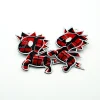
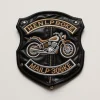
The resulting sample patches:
- Accurately reproduced the original artwork
- Preserved color transitions and fine details
- Matched the intended visual depth of the design
- Reduced overall project cost significantly
The client approved the sample, confident that the final product met both aesthetic and budget expectations.

Key Lessons From This Full-Color Leather Patch Case
1. Quantity Directly Influences Process Choice
Not every full-color design should use the same printing method.
2. Printing Plates Are a Hidden Cost
For small batches, setup fees can outweigh production costs.
3. Digital Printing Is Not a Compromise
For complex designs, spray printing can outperform traditional methods.
4. Process Flexibility Creates Value
Choosing the right method is often more important than following the original plan.
FAQ: Full-Color Printed Leather Patches
Q: Can digital spray printing match CMYK color accuracy?
A: Yes. For most designs, spray printing achieves excellent color fidelity and smoother gradients.
Q: Is spray printing suitable for PU leather patches?
A: Absolutely. It bonds well to PU surfaces and performs reliably in patch applications.
Q: When is CMYK plate printing still the better choice?
A: For very large quantities where plate costs can be amortized effectively.
Conclusion
This case demonstrates that producing full-color printed leather patches is not just about printing capability—it’s about matching the right process to the order scale and design complexity.
By shifting from traditional CMYK plate printing to digital spray printing, the client achieved:
- Better design reproduction
- Faster sampling
- Lower total cost
A clear example of how informed process selection leads to better outcomes for both brand and supplier.
About Author
——————————————————————————————————————————————

Mary
Sales Manager
Hi, I’m Mary. Passionate about exploring new industry trends, I stay ahead of the curve and offer clients forward-thinking solutions tailored to their needs.
——————————————————————————————————————————————