Fashion brands are facing a new challenge: how to make product information more transparent, traceable and accessible throughout the product lifecycle.
One of the most discussed developments is the Digital Product Passport (DPP).
Under the European Union’s Ecodesign for Sustainable Products Regulation (ESPR), textile and apparel products have been identified as a priority product group for future Digital Product Passport requirements. The European Commission currently indicates that the textile-specific delegated act is planned for 2027, although the detailed requirements and implementation timeline are still being developed.
For fashion brands, this is more than a compliance topic.
It may also change how labels, hangtags, QR codes, RFID/NFC solutions and other garment trims are designed and used.
So what should apparel brands and trim suppliers be thinking about today?
What Is a Digital Product Passport?
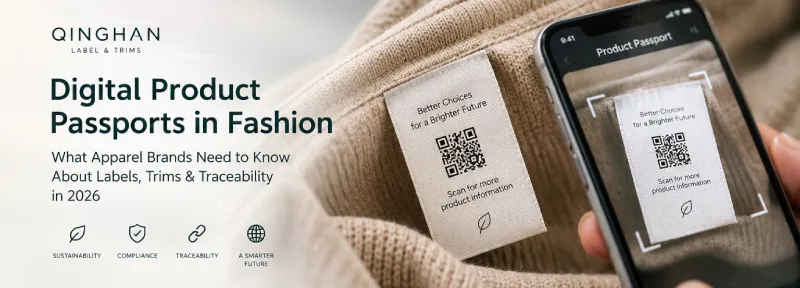
A Digital Product Passport is essentially a digital record connected to a physical product.
Instead of relying only on information printed on a traditional care label or hangtag, a consumer or another stakeholder could access additional product information digitally through a data carrier attached to the product.
Depending on the final requirements, this could include information such as:
Product identification
Fibre composition
Origin information
Sustainability-related information
Repair and maintenance information
Reuse and recycling information
Information about relevant economic operators
Product lifecycle information
The European Commission describes the DPP as a tool to improve transparency across textile value chains and provide information that can support reuse, repair, recycling and more informed purchasing decisions.
In simple terms:
The physical label identifies the product.
The digital layer can provide much more information about it.
Why Does This Matter to Apparel Labels?
At first glance, DPP may sound like a software or compliance issue.
But there is an important physical component:
How does the consumer access the digital information?
The European Commission states that the DPP will be accessible through a data carrier on the product, such as a QR code.
This creates new possibilities for garment trims.
For example:
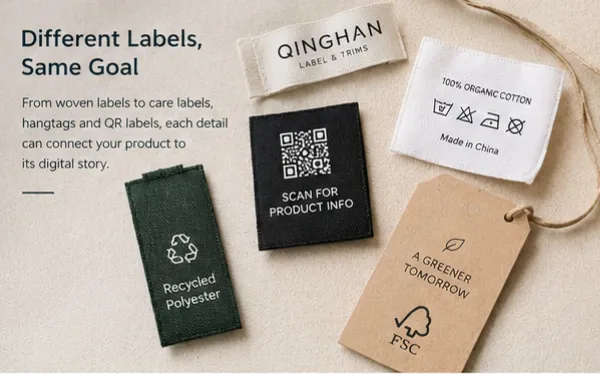
Woven labels
A QR code or other machine-readable identifier could potentially be integrated into a woven label, provided the final technical requirements are met.
Printed care labels
A QR code can be incorporated into the care label while keeping the traditional washing and fibre information.
Hangtags
Hangtags provide more space for QR codes, product information and brand storytelling.
RFID / NFC labels
For brands requiring more advanced digital identification or supply-chain applications, RFID or NFC may become part of a broader product identification system.
The exact requirements for textile DPPs are not yet final, so brands should avoid treating today’s technical assumptions as final legal requirements.
But the direction is clear:
Physical trims are becoming an increasingly important bridge between the physical garment and its digital information.
The Quality of the Label Data Matters More Than Ever
Digital traceability only works if the underlying product information is accurate.
This is particularly important for fibre composition and product labelling.
In a 2026 EU market surveillance campaign, authorities tested 132 clothing products and found that 49 products, or 37%, had labels that did not correctly reflect the materials used. The issues included incorrect fibre percentages, undeclared cheaper fibres and incorrect fibre names.
This highlights an important point:
A digital passport cannot solve inaccurate product information.
If the physical product data is wrong, putting that information into a QR code does not make it more reliable.
For brands, this means that traceability needs to start much earlier in the supply chain.
And this includes trims.
What Should Brands Prepare Now?
The textile-specific DPP requirements are still under development, so brands do not need to redesign every label immediately.
However, there are several practical steps brands can take now.
① Start organizing product data
Brands should understand what information they already have for each product.
For example:
Fibre composition
Material suppliers
Country of origin
Manufacturing location
Certifications
Recycled content
Care instructions
Repair information
Recycling information
The earlier this information is organized, the easier it will be to connect it to future digital systems.
② Think about the physical location of the data carrier
A QR code cannot simply be added at the last minute.
Brands should consider:
Where should the data carrier be placed?
Possible locations could include:
Care labels
Brand labels
Hangtags
Packaging
Other garment trims
The choice depends on the garment, washing requirements, durability, aesthetics and the final regulatory requirements.
For example, a QR code on a hangtag may be easy to scan at retail, while a code integrated into a permanent garment label may remain with the product for longer.
QR Codes on Labels Are Not as Simple as They Look
One of the challenges we often see in label development is that a QR code may look perfect on screen but become difficult to scan after production.
Several factors can affect scanning performance:
Label size
A very small label limits the available area for a QR code.
Weave structure
High-density woven labels can create excellent visual quality, but very small QR elements may require careful testing.
Printing process
Ink spread, substrate texture and printing resolution can affect readability.
Garment washing
If the QR code is placed on a care label, repeated washing may affect its readability.
Colour contrast
A beautiful low-contrast design may not necessarily be suitable for machine-readable information.
This means that design and functionality need to be considered together.
Sustainability Claims Need Better Evidence
DPP is also connected to a broader shift in how fashion brands communicate sustainability.
Brands increasingly use terms such as:
Recycled
Organic
Responsible
Sustainable
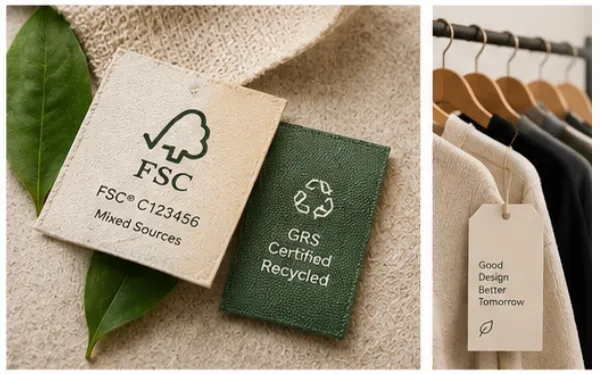
FSC-certified
GRS-certified
But sustainability claims need to be supported by reliable information and appropriate certification.
This is particularly relevant for garment trims.
For example, a brand may want to specify:
GRS recycled polyester label
rather than simply calling the label:
eco-friendly label
The first statement can be connected to a defined material/certification claim. The second is much broader and requires substantiation.
Textile Exchange is also transitioning its existing standards system toward the new Materials Matter Standard, which becomes effective at the end of 2026 and mandatory for relevant audits from the end of 2027.
For brands and suppliers, this reinforces a broader trend:
Sustainability claims are moving from marketing language toward documented product information.
What Does This Mean for Trim Suppliers?
For trim suppliers, the future challenge is not simply:
“Can you make a label with a QR code?”
The more important question is:
Can you help the brand choose a label structure that remains functional throughout the product lifecycle?
For example, a supplier may need to consider:
Material → Printing/Woven Structure → QR Readability → Washing → Durability → Certification → Traceability
This requires collaboration between the brand, designer, trim supplier, garment factory and potentially digital traceability providers.
In other words:
The trim supplier is becoming part of the product information system.
What Could the Future Garment Label Look Like?
Imagine a garment label containing:
Brand Logo
Made in…
Fibre Composition
Care Instructions
Certification Mark
QR Code
The consumer scans the QR code.
Instead of seeing only a product webpage, they could potentially access a structured digital product record containing information about:
Materials → Manufacturing → Certifications → Care → Repair → Reuse → Recycling
This is one possible direction for the industry.
The exact information requirements and implementation details for textile DPPs are still being developed by the EU, so brands should treat this as a direction of travel rather than a finalized label specification.
How Can Brands Prepare Without Overcomplicating Their Labels?
You don’t need to redesign every label tomorrow.
A practical approach is to start with three questions:
- Is our product information accurate?
Check fibre composition, certification claims, origin and other product data.
- Can our labels accommodate future digital information?
Consider whether your current label construction leaves enough space for a QR code or other identifier.
- Can our trim supplier support development and testing?
Discuss QR readability, washing durability, material selection and production feasibility before finalizing the artwork.
A small change during the development stage can be much easier than changing the label after bulk production.
The Future of Fashion Labels Is More Than Decoration
For decades, garment labels have mainly served three purposes:
Branding.
Care instructions.
Product identification.
The next generation of labels may need to do more.
They may become a physical interface between the garment and its digital identity.
That means the best label is not necessarily the one with the most complicated technology.
It is the one that successfully combines:
Design + Function + Durability + Compliance + Traceability
At Qinghan Garment Accessories, we believe trim development should start with the end use—not simply the artwork.
Whether you are developing a woven label, printed care label, hangtag, QR-enabled label or other garment accessory, discussing the application requirements early can help avoid costly changes later.
The future of garment labels is not just about what they say.
It is about what they can connect.
About Author
——————————————————————————————————————————————

Vicky
Sales Manager
Hi, I’m Vicky,.With extensive industry experience and a well-rounded skill set, I excel in both team collaboration and customer service, always maintaining professionalism and efficiency to ensure the best client experience.
——————————————————————————————————————————————