When you see a silicone logo with very fine lines and detailed artwork, screen printing silicone may seem like the obvious production method. However, line thickness is only one factor in process selection. Product thickness, dimensional changes, layering, and 3D structure can also determine whether screen printing or molded silicone is the right solution.
Why Fine Lines Do Not Always Mean Screen Printing
When evaluating a silicone logo from a product image, the first thing we usually notice is its appearance.
If the logo has:
- Nếp nhăn nhỏ
- Chi tiết nhỏ
- A relatively flat appearance
- A clean and precise surface
it is natural to assume that it should be produced using screen printing silicone.
Screen printing silicone is indeed well suited to many fine-line designs. Silicone ink can be applied through a screen to create relatively thin raised details, making it a practical option for logos, lettering, and graphic elements that require a clean and relatively flat appearance.
But appearance alone does not tell the entire story.
A recent customer project demonstrated why a more detailed engineering review is sometimes necessary.
The Logo Looked Like a Typical Screen-Printed Silicone Design
At the beginning of the project, the customer provided a product image of the silicone logo.
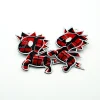
From the image, the logo appeared to have relatively fine lines and a smooth, flat appearance. Based on these visual characteristics, our initial assumption was that it could be produced as a conventional screen-printed silicone logo.
If we had evaluated the product only from the photograph, this would have been a reasonable first assessment.
However, the customer later provided the original artwork and product source file.
This revealed an important structural detail that was difficult to identify from the product image.
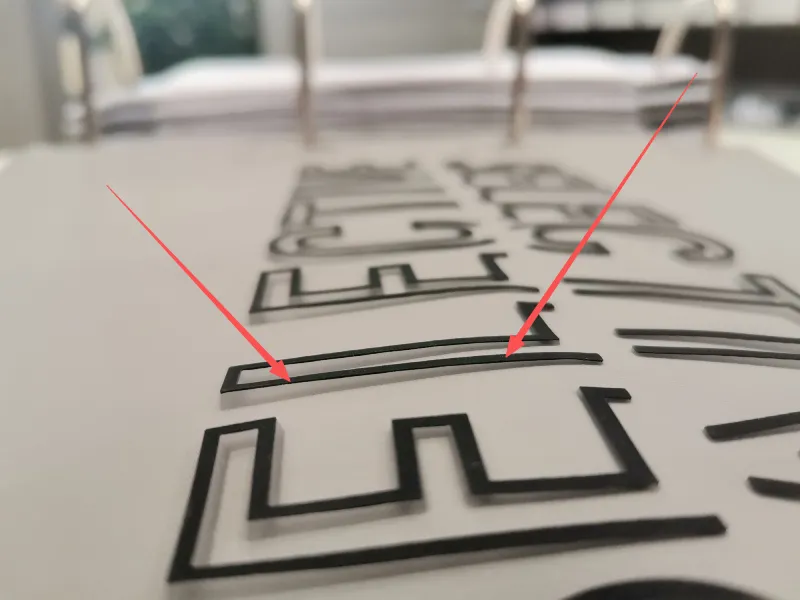
The logo was not actually a simple flat silicone mark. Instead, it had an irregular thickness structure, with the thickness gradually changing from the lower section toward the upper section.
The overall thickness ranged approximately from 0.5 mm to 2.5 mm.
That changed the process evaluation completely.
The Hidden Factor: Thickness and 3D Structure
The key lesson from this project is that fine lines are only one visual characteristic of a silicone logo.
The production method also depends on the physical structure of the product.
For example, two logos may both have extremely fine lines, but their manufacturing requirements can be completely different.
A relatively flat silicone logo with fine printed details may be suitable for screen printing.
Another logo may have the same fine-line appearance but also require:
- Significant thickness variation
- Raised and recessed areas
- Multiple height levels
- An irregular three-dimensional profile
- A specific transition between different thicknesses
In such cases, the structure itself becomes a major factor in process selection.
This is why the original artwork, dimensions, and structural information can sometimes be more important than a product photograph.
Why Screen Printing Silicone Was Not the Right Solution for This Case
Screen printing silicone works by applying silicone ink through a prepared screen onto a suitable substrate.
It is particularly useful when the required effect is relatively thin and surface-oriented.
For example, it can be suitable for:
- Fine-line logos
- Chữ nhỏ
- Graphic patterns
- Multi-color silicone printing
- Slightly raised surface effects
- Designs where the overall thickness remains relatively controlled
However, the customer’s logo required a thickness transition from approximately 0.5 mm to 2.5 mm.
That is no longer simply a question of printing a fine graphic onto a surface.
The required effect was part of the physical structure of the logo itself.
Trying to treat this type of product as a conventional screen-printed silicone logo could result in an inaccurate interpretation of the customer’s intended dimensions and three-dimensional effect.
Therefore, our engineering team reviewed the product structure again instead of choosing the process based only on the fine-line appearance.
The Final Solution: Molded Silicone with Controlled Thickness
After reviewing the artwork, thickness requirements, and production feasibility with our engineering team, we determined that a molded silicone process using controlled silicone filling/deposition was more appropriate for this design.
The objective was not simply to reproduce the graphic outline.
The production process needed to reproduce the changing thickness and three-dimensional structure of the logo.
This approach allowed the silicone material to form the required profile rather than relying on a relatively flat screen-printed layer.
For this type of product, the mold becomes an important part of the engineering process.
The mold geometry needs to account for:
- Overall product dimensions
- Different thickness zones
- Height transitions
- Fine-line details
- Định nghĩa cạnh
- Material flow and filling
- Demolding requirements
The exact process parameters will depend on the silicone material, equipment, mold design, and product structure, so thickness values should be treated as project-specific rather than universal production standards.
What Really Determines the Silicone Production Process?
This case shows why choosing a process based on one visual feature can be misleading.
When evaluating a custom silicone logo, manufacturers should consider several factors together.
1. Line Width
Fine lines and small details can make screen printing an attractive option, particularly when the design is primarily a surface graphic.
However, line width should not be evaluated independently.
2. Overall Thickness
Thickness is one of the most important factors in distinguishing a surface effect from a structural 3D product.
A thin, relatively uniform silicone layer may be suitable for screen printing, while a product with substantial thickness variation may require a molded construction.
3. Thickness Variation
A logo that gradually changes from one thickness to another requires more than simply reproducing a graphic.
The production process must control the three-dimensional profile.
This was the critical factor in our customer’s project.
4. Number of Layers or Height Levels
Some silicone logos contain multiple levels or distinct raised areas.
If the design requires several height transitions, the mold and production process need to be evaluated accordingly.
5. Required Surface Effect
The customer may want a smooth, raised, dimensional, matte, glossy, or textured effect.
The desired visual and tactile result can influence which process is most suitable.
6. Quantity and Production Efficiency
The expected order quantity also matters.
Screen printing can be attractive for certain designs because it avoids the same type of tooling investment associated with a molded product.
For larger-volume production, however, a mold-based solution may provide better consistency when the design depends heavily on three-dimensional geometry.
The best choice therefore balances design requirements, structural complexity, production feasibility, tooling cost, and expected volume.
Screen Printing Silicone vs. Molded Silicone
The following comparison can be used as a starting point when evaluating a silicone logo:
| Nhân tố | In lụa trên silicone | Molded Silicone |
|---|---|---|
| Nếp nhăn nhỏ | Excellent for many designs | Also possible with suitable mold design |
| Overall thickness | Generally thinner | Can support greater thickness |
| Thickness variation | More limited | More suitable for controlled 3D thickness |
| Cấu trúc 3D | Hạn chế | Stronger capability |
| Surface graphic effects | Xuất sắc | Possible |
| Tooling | Screen required | Mold required |
| Complex geometry | More limited | Linh hoạt hơn |
| Suitable applications | Fine graphics, logos, text | Dimensional logos, shaped structures, variable thickness |
This does not mean that molded silicone is always better than screen printing.
The correct process depends on what the customer actually needs the finished product to look and feel like.
Why the Original Artwork Matters
One of the most important lessons from this project is the value of reviewing the original artwork and technical information.
A product photograph shows the appearance of the finished product.
It does not necessarily show:
- Exact thickness
- Hidden structural transitions
- Layer construction
- Mold geometry
- Height differences
- Manufacturing tolerances
For custom silicone logos, this information can significantly change the recommended production process.
That is why an experienced manufacturer should not immediately quote a process simply because a product looks similar to something previously produced.
Instead, the artwork, dimensions, structure, and intended effect should be reviewed together.
A Practical Way to Evaluate Fine Line Silicone Logos
When sending a fine-line silicone logo to a manufacturer, buyers can provide several pieces of information to make the engineering assessment more accurate:
- Original vector artwork – preferably AI, PDF, or another editable vector format.
- Finished dimensions – including length, width, and any critical dimensional requirements.
- Thickness requirements – especially if different areas have different heights.
- Reference photos – useful for showing the intended appearance and surface effect.
- Cross-section or side-view drawings – particularly valuable for irregular 3D structures.
- Application method – such as sew-on, heat transfer, adhesive backing, or other attachment methods.
- Expected quantity – because tooling and production efficiency can affect the most economical process.
The more complete the information, the easier it is for the manufacturer to determine whether the design should be screen printed, molded, or produced using a combination of processes.
Frequently Asked Questions About Fine Line Silicone Logos
Are all fine line silicone logos made by screen printing?
No. Fine lines are often suitable for screen printing, but they do not automatically determine the manufacturing process. Thickness, height variation, 3D structure, and the intended surface effect also need to be considered.
When is screen printing silicone a good choice?
Screen printing silicone is often suitable for relatively flat designs that require fine graphics, small text, clean lines, or a thin raised silicone effect.
When is molded silicone more appropriate?
Molded silicone is generally more suitable when the design depends on three-dimensional geometry, significant thickness, multiple height levels, or controlled thickness variation.
Can molded silicone still reproduce fine lines?
Yes, depending on the artwork, mold design, material, and production capability. Fine details are not exclusive to screen printing, although extremely small features may require engineering adjustments to remain manufacturable.
Why can’t a product photo alone determine the production process?
A photograph mainly shows the external appearance. It may not reveal exact thickness, hidden layers, height transitions, or other structural information that affects manufacturing.
Final Thoughts: Look Beyond the Fine Lines
A silicone logo may look like a simple fine-line design, but its manufacturing process can depend on details that are not immediately visible.
In this customer project, the initial product image suggested a conventional screen-printed silicone logo. After reviewing the original source file, however, we discovered an irregular thickness structure ranging from approximately 0.5 mm to 2.5 mm. That structural requirement meant the product needed to be evaluated as a three-dimensional molded silicone component rather than simply as a flat silicone print.
The key lesson is simple:
Fine lines do not automatically mean screen printing.
Khi đánh giá fine line silicone logos, look beyond the graphic itself. Thickness, height variation, layers, 3D structure, application method, and production quantity can all influence the final manufacturing process.
Sometimes, the most important engineering information is exactly what cannot be seen from the product photo.
Giới thiệu về tác giả
——————————————————————————————————————————————

Mary
Trưởng phòng Kinh doanh
Xin chào, tôi là Mary. Với niềm đam mê khám phá các xu hướng mới trong ngành, tôi luôn đi đầu trong việc cập nhật xu hướng và cung cấp cho khách hàng những giải pháp tiên tiến, được thiết kế riêng biệt để đáp ứng nhu cầu của họ.
——————————————————————————————————————————————