When developing fleece-based apparel trims or textile products, sublimation printing on fleece can create vibrant and detailed graphics. However, fleece materials behave differently from smooth fabrics during printing and laser cutting.
In a recent fleece sublimation development project, we identified two issues that are easy to overlook:
- The surface appeared slightly whitish after sublimation.
- Laser-cut edges showed fuzziness and loose fibers.
If these problems are only discovered during bulk production, they can lead to additional rework costs and delays. Therefore, it is important to evaluate both the material and the finishing process during the sampling stage.
Why Does Fleece Look Whitish After Sublimation?
One common concern with sublimation printing on fleece is that the surface may appear lighter or slightly whitish after printing.
This does not necessarily mean that the sublimation color is incorrect.
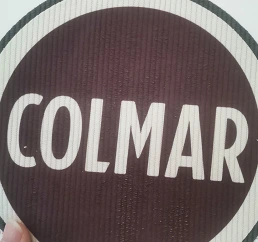
Fleece has a raised fiber surface. When the fibers are touched, rubbed, compressed, or brushed in different directions, they reflect light differently.
As a result, the same printed area can appear darker or lighter depending on:
- Fiber direction
- Fiber length
- Fiber density
- Текстура поверхности
- Viewing angle
- Lighting conditions
For example, when the fleece fibers are brushed in one direction, the surface may look darker. When they are pushed in the opposite direction, more light may be reflected from the surface, creating a lighter or whitish appearance.
Therefore, during development, the sample should be evaluated from different angles and under different lighting conditions rather than judged from only one viewing position.
Shorter and Denser Fleece Is Often Easier to Control
A common misconception is that thicker and longer fleece automatically produces a better product.
Longer fibers may provide a softer and more luxurious hand feel, but they can also create additional production challenges.
Long fibers are more likely to:
- Change direction during handling
- Become flattened or compressed
- Produce visible color variation
- Create uneven sublimation results
- Affect laser-cutting quality
For sublimation printing on fleece, a material with short, dense, and relatively uniform fibers can often provide better consistency.
However, the final material should still be selected according to the intended product. The goal is to balance:
Hand feel + fiber length + fiber density + sublimation performance + cutting performance
Rather than simply choosing the thickest or softest fleece available.
Why Can Laser Cutting Create Fuzzy Edges on Fleece?
Laser cutting is widely used for creating custom shapes and detailed patterns, but fleece presents a particular challenge.
The surface contains many exposed fibers. When the laser cuts through the material, the cutting process can leave:
- Fuzzy edges
- Свободные волокна
- Exposed fibers
- Slightly uneven edges
- Loose or frayed areas
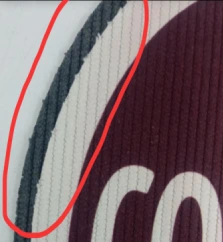
The problem can become more noticeable with materials that have a pronounced surface structure.
For example, corduroy and other ribbed fabrics may produce different cutting results depending on where the cutting line crosses the fabric structure.
Laser Parameters Need to Be Tested
Laser cutting quality is affected by several parameters, including:
- Laser power
- Cutting speed
- Number of passes
- Focus
- Толщина материала
- Fiber structure
Increasing laser power does not necessarily produce a better result.
Too much energy can cause excessive heat and may damage the surrounding material, while insufficient energy may leave fibers incompletely cut.
Therefore, the appropriate parameters should be determined through testing with the actual material rather than relying only on standard settings.
It is also important to understand that some fleece materials have inherent structural characteristics that make it impossible to completely eliminate every trace of fiber fuzziness.
The goal should be to achieve an edge that is clean, stable, and acceptable for the intended application, rather than assuming that every fleece material can produce a perfectly smooth edge.
Test Sublimation and Laser Cutting Together
For products that require both sublimation printing and laser cutting, testing the two processes separately is not enough.
The actual combination should be evaluated during development.
We recommend checking:
1. Sublimation Color
Test whether the printed colors meet the expected appearance after sublimation.
2. Fiber Direction
Check the design from different fiber directions to determine whether the surface creates noticeable color variation.
3. Touch and Friction
Rub and handle the sample to see whether changes in fiber direction significantly affect the appearance.
4. Laser-Cut Edges
Test the actual cutting outline and inspect the edges for fuzziness, loose fibers, and fraying.
5. Large and Dark Graphics
Large solid-color areas and dark graphics can make surface irregularities more noticeable, so they should be tested separately.
6. Real Application Conditions
Finally, evaluate the product in the environment where it will actually be used.
A sample that looks good under studio lighting may appear different on an actual garment, hat, bag, or other textile product.
Why Sampling Is So Important
The biggest advantage of thorough sampling is that material and process problems can be discovered before bulk production.
For fleece products involving sublimation and laser cutting, we recommend completing the following tests during development:
Material Selection → Sublimation Test → Fiber Direction Test → Touch Test → Laser Cutting Test → Edge Inspection → Final Application Test
This process helps determine whether the selected fleece is suitable for the entire production process.
A successful product is not simply about getting the sublimation color right. The material must also work well with the cutting process and maintain an acceptable appearance during actual use.
FAQ: Sublimation Printing on Fleece
Why does fleece look lighter after sublimation?
The raised fibers can change direction during handling or printing. Different fiber directions reflect light differently, which can make the surface appear lighter or whitish.
Is longer fleece better for sublimation printing?
Not necessarily. Longer fibers can provide a softer feel but may also create more visible changes in color, fiber direction, and surface appearance.
Why does laser cutting fleece create fuzzy edges?
Fleece contains many exposed fibers. Laser cutting can leave loose fibers or fuzzy edges depending on the material structure and cutting parameters.
Can laser-cut fleece edges be completely smooth?
Not always. Laser power, speed, focus, and cutting passes can improve the result, but some fleece materials naturally produce slight fiber fuzziness because of their structure.
What fleece is better for sublimation printing?
Shorter, denser, and more uniform fleece is generally easier to control. However, the final selection should also consider hand feel, appearance, cutting performance, and the intended application.
Заключительные мысли
Sublimation printing on fleece requires more consideration than sublimation printing on a smooth textile surface.
The fiber structure can influence color perception, while the same fibers can also affect laser-cutting performance.
For this reason, the best approach is not simply to adjust the printing or laser parameters after problems occur. Instead, material selection and process testing should be carried out together during the development stage.
Identifying these risks before bulk production can help reduce rework, control costs, maintain product quality, and avoid unnecessary production delays.
Об авторе
——————————————————————————————————————————————

Хайди
Менеджер по продажам
Привет, я Хайди, менеджер по продажам. Известная своим профессионализмом и эффективностью, я часто признаюсь лучшим специалистом по продажам. Я верю, что опыт и преданность делу укрепляют доверие клиентов.
——————————————————————————————————————————————